From Draft NOtices, April-June 2025
— Lauren Reyna Morales and Davíd Morales
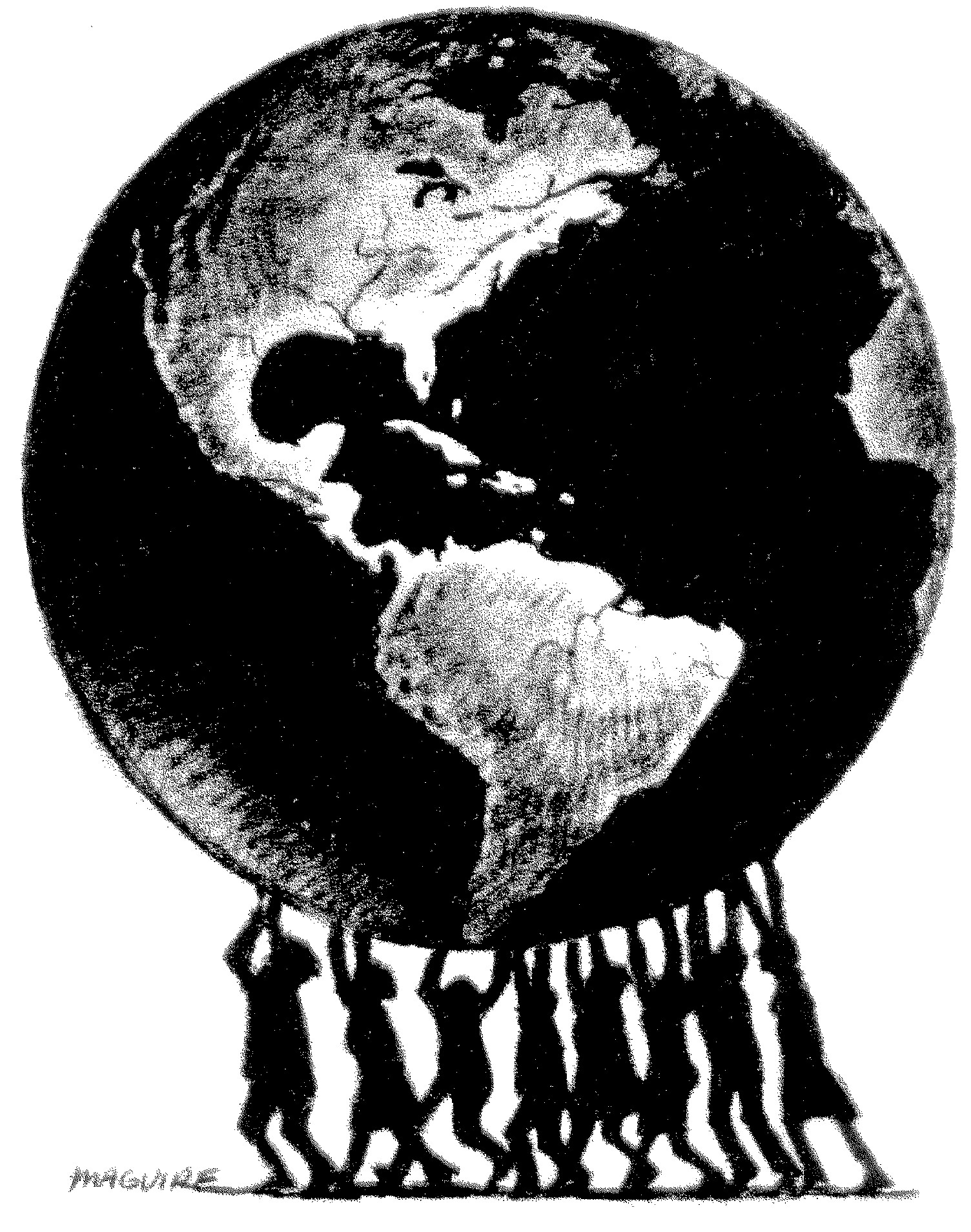
In December 2024, we participated in the 14th International Conference on Education and Justice at the University of Hawai‘i at Mānoa. This was our first time attending the gathering, which is often held in Honolulu and organized by Hawai‘i Scholars for Education and Social Justice, among others. The conference was open to the public and brought together students, educators, activists, and academics. Davíd learned about it through his doctoral work at Stanford’s Graduate School of Education, where he is completing a Ph.D. in Race, Inequality, and Language in Education. Lauren teaches middle school social studies in the Bay Area. Though currently based in the Bay, we serve on the boards of the Project on Youth and Non-Military Opportunities (YANO) and the Committee Opposed to Militarism and the Draft (COMD), both based in our hometown of San Diego, California.
In many ways, Hawai‘i reminded us of San Diego. The beautiful beaches, with a shimmering ocean that kisses the shores under the perfect sun. Exotic flora, meticulously curated in the gardens of beachside hotels that house tourists sporting their newly purchased Hawaiian shirts and blistering sunburns. Military monuments, bases, fixtures, and settlers — via the U.S. Army, Navy, Marines, and more — serve as constant reminders of a colonial and militarized past and present. On the airplane, our eyes surveyed the cabin as we wondered: Did anyone else on this jet come here for something deeper than their own pleasure? Who else is wrestling with the critical awareness that their government has illegally occupied these lands for over a century, shattering communities and traditions?
A group of mainland teenagers wearing plastic leis and Pearl Harbor hats sat in the rows in front of us. Everything indicated they were cadets in the U.S. Army’s Junior Reserve Officers’ Training Corps (JROTC), likely visiting the island for a state-sponsored indoctrination trip disguised as a “learning experience.” Our hearts hurt at the sight — a physical embodiment of military propaganda gripping a new generation of young people, persuading them to dedicate their lives to sustaining America’s imperial projects while further concealing the ongoing harm U.S. militarism inflicts on Hawai‘i.
We believe that there are few, if any, ethical tracts for tourism on lands that were illegally annexed by the United States in 1898. The forceful suppression of Hawaiian sovereignty gave way to the archipelago becoming the 50th state in 1959, despite decades of organized resistance from Kanaka Maoli and their allies. In light of the expressed convictions, you might be wondering, “So why in the hell did we go to O‘ahu, then?” After much reflection and conversation, we came to believe that our own organizing could grow stronger through building ties with these communities and learning from their ongoing resistance.
For some time now, we’ve been thinking more deeply about how racial capitalism and enduring colonial structures deliberately alienate communities — engineering separation and suppressing possibilities for solidarity, collective struggle and joint analysis across distinct contexts and geographies. There are a couple of scholars who have helped us understand this more clearly. Ruth Wilson Gilmore (2002) and Jodi Melamed (2015) theorize racial capitalism as a “technology of antirelationality” that disjoins or deactivates relations between human beings to better facilitate capitalist expropriation. This framing has helped us recognize how the isolation of some communities is not incidental but structured, and how the fragmentation of struggles serves to protect systems of domination. This fragmentation occurs through the imposition of borders, notions of legality and citizenship, war and militarization, among other mechanisms. These conditions make it harder for communities to recognize their shared conditions and collective stakes. We’ve come to understand that this is especially true in the case of Hawai‘i, where we have not yet developed deep or sustained relationships with those doing decolonial and anti-militarist work.
It was with this understanding — and in the face of these technologies of antirelationality — that we chose to travel to Hawai‘i with intentions that departed from the all-too-common patterns of touristic and extractive travel. We approached our trip and participation in the Education and Justice Conference as a small intervention, an attempt to resist the structures that foreclose solidarity and collective analysis among communities resisting oppression across distinct geographies. We were mindful that any visit to a place like Hawai‘i, a site of ongoing U.S. occupation and Indigenous struggle, carries contradictions. Still, we hoped that our presence would be shaped by solidarity and reciprocity and that our engagements with Kanaka Maoli and other communities in resistance might reflect a commitment to relational accountability rather than extraction. We saw our time in Hawai‘i as an opportunity to connect with communities resisting militarism and to share insights from our own organizing work against militarism in a San Diego context.
Our presentation for the conference was titled “Militarism as Technology of Anti-Relationality: Resisting School Militarization and Practicing Solidarity Across Geographies in Defiance of U.S. Militarism.” In a classroom at the University of Hawai‘i, filled with students, educators, and academics from Hawai‘i and beyond, we contended that the militarization of schools and communities is fundamentally irreconcilable with democracy, human rights, and sovereignty. The U.S. military has a long and ongoing history of intrusion into educational institutions across its states and territories — including both Hawai‘i and San Diego — where schools have served as key sites for recruiting young people and sustaining the growth and dominance of U.S. empire. Today, as recruitment quotas continue to fall short among newer generations, we are seeing increasingly predatory and coercive recruitment strategies.
Following Gilmore and Melamed, we conceptualized the U.S. military as a technology of antirelationality, one that brings racialized and marginalized peoples together across the globe, but only in ways that serve empire, often pitting communities against one another who have more in common than they do with those in power who deploy them. We discussed how heavily militarized communities, such as those in Hawai‘i and San Diego, are often both resources for militarization and targets of it. (Sixty percent of public high schools in Hawai‘i have JROTC units, according to a 2017 RAND Corporation report.) Young people from these communities are recruited to serve as cannon fodder while simultaneously facing the environmental and social devastation wrought by the military-industrial complex at home. We shared examples from our counter-recruitment work with Project YANO, including some key organizing victories and ongoing resistance to the involuntary enrollment of students into JROTC programs. We also invited participants to share their own experiences with militarism in their communities, creating space for dialogue and collective reflection.
We heard presentations from local organizers as well as attendees from across the Pacific and beyond. We learned from those advancing education sovereignty in Hawai‘i, and from Indigenous and migrant communities sharing both the challenges they face and the strategies they’ve developed to resist. One session mentioned the ongoing environmental devastation caused by the U.S. Navy on O‘ahu — particularly the 2021 Red Hill disaster, when tens of thousands of gallons of jet fuel leaked from the Red Hill Bulk Fuel Storage Facility into the soil and groundwater, contaminating local water supplies. We learned about the powerful efforts underway to hold the military accountable and demand environmental justice. We also participated in a decolonial huaka‘i (walking tour) of the UH Mānoa campus, which centered Indigenous geography, local histories, and the original stewards of the land.
As we boarded our flight back to San Francisco, we watched other passengers wrap up their vacations, likely returning home with souvenirs and sun-soaked memories. Sitting on the plane, watching the lush valleys and mountains disappear beneath the clouds, our minds were alive with reflections. It felt like an undeserved honor to spend time on these sacred lands. We hope to continue building relationships with those in resistance, and to return in a spirit of reciprocity and accountability. We know we have much to learn from groups like Hawai‘i Peace & Justice and others leading anti-militarist and decolonial struggles. More exchange, dialogue, and kinship — across and in defiance of colonial borders — can only strengthen our collective efforts against militarism and its devastating impacts on this planet.
Information sources:
-
Melamed, J. (2015). “Racial capitalism.” Critical Ethnic Studies, 1(1), 76–85.
-
Gilmore, R. W. (2002). “Fatal couplings of power and difference: Notes on racism and geography.” The Professional Geographer, 54(1), 15–24.
This article is from Draft NOtices, the newsletter of the Committee Opposed to Militarism and the Draft (http://www.comdsd.org/).