- Rick Jahnkow
- Articles Archive
- Hits: 5736
San Diego Students Give Pink Slip to High School Military Program
From Draft NOtices, April-June 2012
The lesson for their principal: Militarism at school isn’t cool!
— Rick Jahnkow
 Students at Mission Bay High School in San Diego are now celebrating what amounts to a very rare organizing victory: the expulsion of a Junior Reserve Officers Training Corps unit from their school. The accomplishment is especially remarkable given that it happened in an area with one of the largest concentrations of military personnel and war industry in the world. San Diego County, with over 100,000 active duty sailors and Marines, has a Department of Defense payroll that frequently tops all other regions in the U.S. It’s not the sort of place where you would expect a rejection of anything military.
There are more than 3000 high schools in the U.S. with JROTC, the Pentagon’s high school military training and indoctrination program. Over the years, those who have objected to having such courses in their schools have learned that when a JROTC unit gets established, it is almost impossible to remove it with a campaign of protest directed at school administrators and governing boards. The reason is that once JROTC is present, the cadets — who are organized in military ranks — can be used as a lobbying force that will intimidate even the most anti-militarist school board. Activists in San Francisco, for example, have failed in multiple attempts to eliminate the program.
This pattern, however, has occasionally been broken. The latest example is at Mission Bay High School in San Diego, where student organizing has now forced the removal of a JROTC unit at the end of the 2011-2012 school year.
The story of this remarkable victory began in the summer of 2007, when Mission Bay principal Cheryl Seelos requested, and received, approval from the San Diego school board for a Marine Corps JROTC unit. Opposition to the program was small at first, but it quickly grew as students and parents learned more about JROTC’s military recruiting function and also heard that college readiness classes like AP Spanish and AVID were being reduced or eliminated. These latter subjects were particularly important as routes to higher education for the school’s mostly Latino student body. People were also shocked to find out that, despite a zero-tolerance policy on weapons, a shooting range would be built inside the school for marksmanship training. When it was discovered that shooting ranges were already in many other schools with JROTC, students and teachers at other San Diego campuses spoke out, which led to the formation of the Education Not Arms Coalition in late 2007.
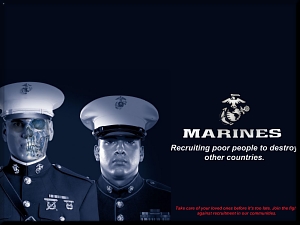 The Latino/a population enlisted in the United States military is rapidly increasing and is projected to be as much as 22.3% of the armed forces by 2020. Without a doubt as the population of Latinos and Latinas increases in the U.S. the amount of Latino/Latina military personnel will do so as well. The Pew Hispanic Center estimates that in 2001 there were 109,487 enlisted soldiers who classified themselves as Hispanics, with 14% of them enlisted in the Marine Corps.