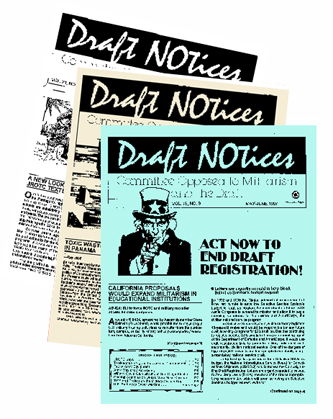
From Draft NOtices, January—March 2010
- Pat Elder
The Armed Service Vocational Aptitude Battery (ASVAB) is a public service provided to high schools free of charge. The program helps teens find their strengths and helps them set goals for their future.
Officials try to keep recruiters away from the test as much as possible.
— DoD statements on the ASVAB
Every school year hundreds of thousands of high school students across the country are encouraged — and often required — to take a four-hour military exam during school hours. The test, with a name few can remember (the Armed Services Vocational Aptitude Battery, or ASVAB), is an integral part of the Pentagon's overall recruitment program. Heightened public concerns about the administration of the school testing program are contributing to its decline, particularly in the last few years.
Many school officials, persuaded by claims that the ASVAB helps students choose appropriate careers, encourage students to take the test. Since 1968 the Pentagon has used the ASVAB to gather a treasure trove of data on 16- and 17-year-olds. ASVAB data goes beyond the name, address, and phone numbers of high school students that military recruiters may receive as a result of the No Child Left Behind Act passed in 2001. Students who take the ASVAB divulge their Social Security number, gender, race, ethnicity, birth date, statement of future plans, and, significantly, their aptitude in ten critical subtest areas.
The ASVAB is the military's entrance exam given to all fresh recruits to determine their aptitude for various military occupations. The test was also administered to 621,000 students in 11,900 high schools across the country during the 2006-2007 school year, the last year for which such data is available. Nationally, the number of students taking the ASVAB dropped 19 percent from 2002 to 2007, accelerating a steady decline that began in 1990.
.jpg) As a third generation Japanese American, I didn’t have much of a connection to Japan. It seemed much too expensive for a visit, and like others of my generation, my life was in America. However, in my late forties I applied for a Fulbright Scholarship for a month in Japan along with a team of 12 educators from throughout the United States. It was an opportunity for me to discover my cultural heritage and understand my life experience as a Japanese American woman. One of the moments that impacted me the most was standing on ground zero at Hiroshima and Nagasaki, imagining the 175,000 children and adults killed in an instant from the atomic bomb. I also had an “ah-hah” moment after seeing photographs of the young boys in Japan who were sent to war -- they looked nothing like the images that were depicted in America. Going to Japan put in context the experience of my family, which was forcibly incarcerated in the camps at Manzanar during World War II, and it gave me an understanding of who I am and where I’ve come from.
As a third generation Japanese American, I didn’t have much of a connection to Japan. It seemed much too expensive for a visit, and like others of my generation, my life was in America. However, in my late forties I applied for a Fulbright Scholarship for a month in Japan along with a team of 12 educators from throughout the United States. It was an opportunity for me to discover my cultural heritage and understand my life experience as a Japanese American woman. One of the moments that impacted me the most was standing on ground zero at Hiroshima and Nagasaki, imagining the 175,000 children and adults killed in an instant from the atomic bomb. I also had an “ah-hah” moment after seeing photographs of the young boys in Japan who were sent to war -- they looked nothing like the images that were depicted in America. Going to Japan put in context the experience of my family, which was forcibly incarcerated in the camps at Manzanar during World War II, and it gave me an understanding of who I am and where I’ve come from.