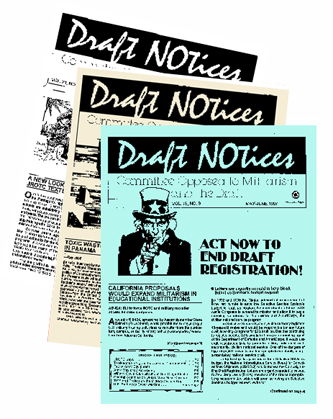
From Draft NOtices, July—September 2010
Protests, arrests, vigils, boycotts, and message force Army to retreat.
—Pat Elder
 A coalition of about 30 peace groups has proven triumphant in its goal of shutting down the Army Experience Center (AEC) in a suburban shopping mall in Philadelphia. The Army announced on June 10 that it will close down the recruitment center on July 31, 2010, four months before its lease expires.
The beleaguered $13 million, 14,500 square foot AEC at Franklin Mills Mall has been the center of controversy since it opened its doors in August of 2008. Its closure is a testament to the steely resolve of a handful of activists from New York to Maryland who were intent on the facility's demise. They organized several protests of hundreds of people that resulted in a dozen arrests, as well as regular vigils and a boycott of mall owner Simon Property Group, Inc.
Witnessing 13-year-old boys giving each other high fives for "blowing away ragheads" while the simulated blood of Afghans poured on their screens provided enough stimulus to turn outrage to action. The U.S. Army was ultimately forced to retreat, bringing to mind the revolutionary words of Margaret Mead: "Never doubt that a small group of thoughtful, committed citizens can change the world; indeed, it's the only thing that ever has."
The AEC boasts dozens of video game computers and X-Box consoles with various interactive, military-style shooting games. The facility has sophisticated Apache helicopter and Humvee simulators that allow teens to simulate battlefield killing. Philadelphia Inquirer reporter Rob Watson compared the Army Experience Center to "a heavy dose of candy cigarettes."

Committee Opposed to Militarism and the Draft (COMD)
- Pat Elder and Rick Jahnkow
- Articles Archive
- Hits: 3350
Maryland Legislature Votes to Ban Testing for Military Recruitment
From Draft NOtices, April—June 2010
– Pat Elder and Rick Jahnkow
On March 24, the Maryland Senate narrowly approved a measure that will prohibit the automatic release of aptitude test results to military recruiters by public schools. The vote was 24-23.
Earlier, the Maryland House of Delegates passed the same measure 102-37. Supporters of the Student Privacy Protection Act expect Governor O’Malley to sign the bill into law [see postscript].
Opponents argued that the bill was unpatriotic and anti-military, particularly in a "time of war." Senator Jaimie Raskin, who introduced the legislation, said the measure was needed because the Armed Services Vocational Aptitude Battery (ASVAB) was being administered in Maryland's high schools without parental consent, and results from the test were being forwarded to military recruiters. To correct this, the bill requires the selection of ASVAB Recruiter Release Option 8 for all Maryland students taking the test. Option 8 allows students to be given the test without the results being released to recruiters.
The ASVAB is the same test given to new recruits to determine their suitability for various jobs in the military. When given in high schools, it can provide recruiters with extensive personal information on students that is then used to sell them on enlistment. Currently, hundreds of thousands of high school students are tested by the Pentagon during school hours each year, frequently without the recruiting purpose of the test being revealed to students or parents (see January-March 2010 Draft NOtices).
From Draft NOtices, April—June 2010
—Miriam Clark
This was the title of a book written by Major General Smedley D. Butler after spending 34 years in the U.S. Marine Corps. At the time he wrote it in 1935 he was the most decorated military person in the history of the United States.
In his book he presented an exposé and condemnation of the profit motive behind warfare. His views on war were summarized in the following passage from a 1935 issue of “the non-Marxist, socialist” magazine, Common Sense – one of Butler’s most widely quoted statements:
“I spent 33 years and four months in active military service and during that period I spent most of my time as a high class muscle man for Big Business, for Wall Street and the bankers. In short, I was a racketeer, a gangster for capitalism. I helped make Mexico and especially Tampico safe for American oil interests in 1914. I helped make Haiti and Cuba a decent place for the National City Bank boys to collect revenues in. I helped in the raping of half a dozen Central American republics for the benefit of Wall Street. I helped purify Nicaragua for the International Banking House of Brown Brothers in 1902-1912. I brought light to the Dominican Republic for the American sugar interests in 1916. I helped make Honduras right for the American fruit companies in 1903. In China in 1927 I helped see to it that Standard Oil went on its way unmolested. Looking back on it, I might have given Al Capone a few hints. The best he could do was to operate his racket in three districts, I operated on three continents.”
Ninth CIRCUIT COURT RULING: CONFRONTING MILITARISM BY USING EQUAL ACCESS TO HIGH SCHOOLS

When the military comes to your local high school, you have a legal right to give students an opposing view. This has been the position taken by federal district courts in Florida, Pennsylvania and Illinois and two federal appellate courts. The most broadly-worded decision came from a case that COMD took to the Ninth Circuit Court of Appeals in the 1980s. Here is the background:


