From Draft NOtices, July-September 2020
Who Joins the Military and Why: An Initial Reconnaissance
Research with potential implications for counter-recruitment work
— Isidro D. Ortiz, Ph.D.
 Change: gentrification
The demographic composition of the American military has been a subject of interest to scholars, journalists and counter-recruitment activists. Some of the last have contended that the composition reflects a “poverty draft.” A recent study provides insight into the issue. “A Mercenary Army of the poor? Technological Change and the Demographic Composition of post-9/11 U.S. Military” by Andrea Asoni et. al, sheds new light on the controversial notion that the “the American military is a mercenary army of the poor.” The investigators break methodological ground by analyzing individual-level data on two national samples covering the period 1979-2005. Their analyses of the data reveal, they claim, that “contrary to accepted wisdom, the U.S. military no longer primarily recruits individuals from the most disadvantaged socio-economic backgrounds.” They also found that, in contrast to the past, those who join the American armed forces are at or above the median with respect to socio-economic indicators such as parental income, parental wealth and cognitive abilities — exactly the opposite of what other studies maintain. In other words, the armed forces recruited primarily from the middle-class sector of society. According to the investigators, at the roots of the change — which some have described as the “gentrification” of the military — are increases in the requirements of the “modern capital-intensive, information dominant, expeditionary American military.” According to the researchers, “the less affluent are less likely to meet such requirements.”
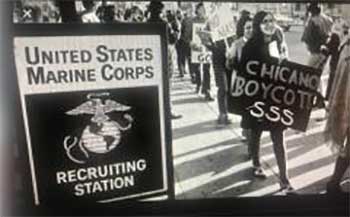 On August 29, 1970, the sounds of “¡Raza Sí, Guerra No!,” and “Chale, No we Won’t Go!” thundered across East Los Angeles as an estimated 30,000 Chicana/os marched to protest the war in Vietnam. The march was one of the events of the Chicano Moratorium (CM). Organized and spearheaded by the National Chicano Moratorium Committee, the CM was the capstone in the Chicano anti-war movement that surged in 1969 and 1970 throughout Aztlán, the mythical Chicano homeland.
 For fourteen years a dedicated group of anti-war citizens in a working-class suburb of Boston, MA, has worked to inform high school students in their community, including their own children, about the perils of military recruitment. Chelsea Uniting Against the War (CUAW) convenes within the first week of the school year to distribute counter-recruitment flyers informing students of the risks of military service. They then follow up this activity by speaking with students one-on-one during school lunch breaks while distributing forms to opt out of school releases of student information to military recruiters. These lunchtime events occurred twice each year and were always preceded by a phone call to the principal’s office to determine an appropriate date. At no time did CUAW enter the school without prior notice.