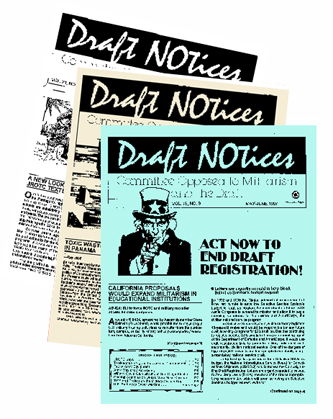
Later this year, the public will have online access to an extensive digitized collection of materials documenting the history of grassroots anti-militarism organizing by the Committee Opposed to Militarism and the Draft (originally named San Diego CARD). The collection consists of materials from 10 scrapbooks covering the late 1970s through 1987, plus every issue of our newsletter, Draft Notices, from 1980 through 2021.
The digitized materials are being hosted online by the Department of Special Collections and University Archives at the University of Massachusetts, Amherst. Digitization was done manually by COMD, with help from Project YANO, and took a year to complete. Approximately 4,000 pages were scanned to create 1,064 PDF files.
The types of documents in the collection will include such items as fliers, memos, news releases and clippings, meeting agendas, brochures and photographs. All the documents will be accessible to Internet search engines.
When the collection is fully uploaded and annotated at UMass, COMD will share its online link. It’s worth noting that the COMD collection will be in the company of the papers of such notable individuals as W.E.B. Du Bois and Daniel Ellsberg.
This article is from Draft NOtices, the newsletter of the Committee Opposed to Militarism and the Draft (http://www.comdsd.org/index.php/draft-notices).
Please consider becoming a $10 per month supporter of The Committee Opposed to Militarism & the Draft
Our investigations and advocacy are an important contribution to the national peace community in the USA.
Donate through the Project on Youth & Non-military Opportunities
###
 When Israeli children play with toy soldiers, it’s not just a game, a fantasy or an aspiration. It is a fact of life that they will serve in the military, usually right after high school. When children hear stories from family members about their time in the military, it is not just from a father or one aunt or cousin. Nearly all (male and female) adult family members have stories to tell about their time in the Israeli Defense Force (IDF). There are exemptions for Orthodox Jews, the mentally or physically unqualified, young mothers, Arab Israelis, and a few others, but it is rare for a citizen to be deemed a conscientious objector. To seek CO status in Israeli society is considered the ultimate betrayal and a process that will bring certain suffering to the individual.