From Draft NOtices, January-March 2019
— Marshall Blesofsky  On February 14, 2018, the unthinkable but all-too-common happened. A mass shooting occurred at the Marjory Stoneman Douglas High School in Parkland, Florida. Rumors about the identity of the shooter were that he was a former student who had been in JROTC. One week later, on Democracy Now, Amy Goodman's guest was Pat Elder, the director of the National Coalition to Protect Student Privacy. This organization works to counter the access that the military has to students in high schools. Mr. Elder went on to state that the shooter was trained in the marksmanship program at the same high school. On the day of the murders, the shooter wore his JROTC shirt. Also, among the killed were three JROTC students.
Long Beach Recruitment Awareness Project (LB RAP) is an organization that has been working to safeguard the privacy of students through what we call truth-in-recruitment. Military recruiters in our school district can visit the schools almost any time they wish. They collect student contact information and use it to pursue them. We have documented cases of students who have been hounded by recruiters without their parents' consent and lured by false promises to join the military.
Our organization was aware that there were two JROTC shooting ranges in Long Beach Unified School District (LBUSD) -- one at Long Beach Polytechnical High School and one at Lakewood High School. I personally had knowledge of the rifle range at Poly High School because both of my children graduated from that school. LB RAP decided to put together a flyer and a petition and begin a campaign to rid the school district of these shooting ranges. On March 24, Long Beach had their own March for Our Lives rally that was organized by high school students in the area. Long Beach Area Peace Network and LB RAP collected signatures and distributed our petition. Many people were shocked to learn that Long Beach Unified School District had these shooting ranges.
We also made this a political issue in the upcoming school board election. We went to candidates’ forums and got the candidates to speak about the issue. Both of the individuals running for the board of education were very supportive. One of them stated that closing these shooting ranges was a no-brainer. After conferring with Pat Elder and Rick Jahnkow of the Project of Youth and Non-Military Opportunities (YANO), we learned that many of these programs were supported by the National Rifle Association (NRA). A local community leader who is not a member of the peace movement sent a Public Records Act request to the district in an effort to learn whether the NRA had ever donated money or in-kind donations to the JROTC programs at the schools. Although it turns out the NRA made no such donations, we speculate that this inquiry made the school district wary of scrutiny around the issue of shooting ranges.

Committee Opposed to Militarism and the Draft (COMD)
From Draft NOtices, October-December 2018
— Edward Hasbrouck 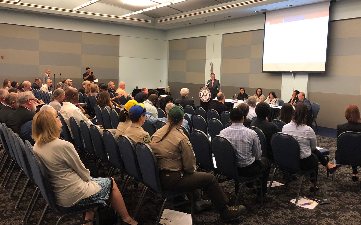 The National Commission on Military, National, and Public Service came to Southern California during September 19-21. It was the only visit west of the Rockies on a national tour of public events, private site visits, and closed-door meetings preparatory to making recommendations to Congress and the President in 2020. The Commission’s recommendations are supposed to address the future of the Selective Service System, draft registration, and a possible special-skills draft or other compulsory service program.
The Commission’s itinerary included a brief public "listening session" at California State University Los Angeles, a visit to the Marine Corps Recruit Depot San Diego, and other undisclosed meetings.
The only public event of the Commission’s three-day SoCal visit was at CSULA. The first hour was devoted to a "service fair" with information tables and recruiters for voluntary service organizations. No counter-recruitment organizations were invited or allowed to participate. The second hour was a panel discussion with four young veterans of the military, the Peace Corps, City Year, and the LA Conservation Corps.
The focus of the panel was on voluntary service. Most of the panelists and participants in the "service fair" hadn't been told that the Commission is tasked by Congress with studying the draft and compulsory service. Several indicated privately that they felt used by the Commission. The agenda and speaker list appeared to have been planned to create a stage-managed and fake appearance of a "consensus" in favor of requiring military or civilian "national service" from all young people.
Despite claims that, "The Commission seeks to learn more about why people serve and why people may choose not to serve,” all of the invited witnesses at all of the Commission's public events throughout the country have been invited as promoters of voluntary service. No one has been invited to speak to the Commission about the reasons people might not serve, or want to serve, in the military.
- Rick Jahnkow
- Articles Archive
- Hits: 5003
Report from the National Counter-recruitment and School Demilitarization Strategy Summit
From Draft NOtices, October-December 2018
— Rick Jahnkow
 During the weekend of June 23-24, 2018, a group of 28 activists gathered in Chicago to share the knowledge and lessons they have learned from organizing to counter the militarization of schools and military recruitment of young people. They came from various regions of the U.S. and met at the Cenacle Retreat and Conference Center.
Sponsored by the National Network Opposing the Militarization of Youth (www.nnomy.org), the gathering provided an opportunity for organizers to assess the context for their work under the Trump/Pence administration, identify individual and collective challenges they face, and evaluate possible strategies and best practices for increasing their impact.
The planning committee for the summit consisted of:
Pat Alviso, Recruiter Awareness Project (Long Beach, CA)
Michelle Cohen, Project Great Futures (Los Angeles, CA)
Kate Connell, Truth in Recruitment (Santa Barbara, CA)
Natasha Erskine, Vets For Peace (Chicago, IL)
Libby Frank, Northwest Suburban Peace Education Project (Chicago, IL)
Rick Jahnkow, Project YANO (San Diego, CA)
Seth Kershner, Winsted Area Peace Action (CT)
Siri Margerin, Full Picture Coalition (Bay Area, CA)
Ninth CIRCUIT COURT RULING: CONFRONTING MILITARISM BY USING EQUAL ACCESS TO HIGH SCHOOLS

When the military comes to your local high school, you have a legal right to give students an opposing view. This has been the position taken by federal district courts in Florida, Pennsylvania and Illinois and two federal appellate courts. The most broadly-worded decision came from a case that COMD took to the Ninth Circuit Court of Appeals in the 1980s. Here is the background:


